



- Product group:
- Carbon-neutral solutions
- Energy production and distribution equipment, components and auxiliary equipment
- Energy storage
- Operation, maintenance and installation
- Other energy sector services and support functions
- Renewable energy
- Sustainable urban and energy infrastructure
Helicasol Oy
- Booth:
- E621
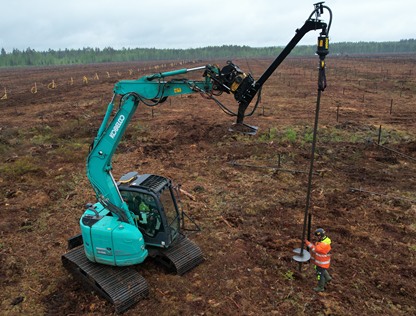
Helicasol delivers foundations for solar parks: fixed-tilt and tracker racking, and battery storage on the same site. On soft clay, peat and organic fill, the helix plate carries the load in stable soil below the weak surface layer and the frost line. Piles are sized from values measured on your site.
Developers get three things before tendering: a feasibility assessment, a proposed optimal foundation solution and a cost estimate. EPCs get design, piles and installation under one contract. Mounting manufacturers gain sites that would otherwise pass them by.
The piles are manufactured in EN 1090 certified production in Finland. Latest: 71,000 piles to the 129 MW Hallanvahti park, in peat up to 9 metres.
Come and talk to us about your site, and we will tell you what it takes.
What we do
Helicasol is a foundation specialist for solar parks. Work often starts with field testing (PoT), to see how piles behave in the ground on your site. From the results, we size the foundations zone by zone. The piles are manufactured in EN 1090 certified production in Finland. We are responsible for the design, the quality and the delivery. We install the piles ourselves, or supply them to the civil works contractor on site. Projects from roughly 1 MWp upwards, smaller sites case by case.
Our latest large delivery is the 129 MW Hallanvahti solar park in Joroinen, one of the largest in Finland: 71,000 piles, in peat up to 9 metres deep.
Who we serve
Project developers. Before you tender to EPCs, you need answers to three questions. Can the site be built? What is the optimal foundation for it? And what will it cost? Based on field testing, we help you choose the right foundation method for the site and for each zone within it, whether that is a helical pile or something else. Cost accuracy improves at the same time. Generic assumptions run 20–40% off; measured data narrows that to 5–10%. On a €10M foundation scope, €2–4M of uncertainty drops to under €500k. Foundations are typically 10–15% of a park’s CAPEX. lp.paalupiste.com/helicasol/developers
EPC contractors. Foundation sits on your critical path and stays on your warranty. Take design, piles and installation as one contract. Or we supply piles, installation criteria and, if needed, training, and your own civil works contractor does the work. lp.paalupiste.com/helicasol/epcs
Mounting system manufacturers. Helical piles open new sites for your racking system: soft clay, peat and frost-affected ground, where capacity comes from below the weak surface layer. You can include the piles in your own supply to the EPC, or we supply the EPC directly and align the technical details with you. The pile-to-frame connection is designed together. Brackets can come from us or from your own production, and you decide which works better. lp.paalupiste.com/helicasol/mounting
Battery storage on the same site
Containers, transformers and inverters are mounted on screw piles, pile caps and a steel frame welded on top of them. The work is done on natural ground, without excavation, soil exchange or concrete. Compared with a cast-in-place concrete foundation it is considerably faster and more cost-efficient, and the carbon footprint is a fraction. lp.paalupiste.com/helicasol/bess-foundations
How we get started
- Input for quotation. An NDA first, if needed. For a solar park we need the ground investigation, site layout, racking drawings with the loads per support point, and the site location. For battery storage: ground investigation, site layout, equipment loads and dimensions, and the site location.
- Field testing (PoT) when needed. Paid, and 50% is credited back if the project goes ahead.
- Design and offer. The ground and the loads determine what kind of pile the site needs: the diameter, the wall thickness, the helix size and count, and the pile length. The number of piles is set by the racking structure in a solar park, and by the ground and the equipment loads and dimensions in a battery compound. A solar park is a large area where the ground can vary, so it makes sense to optimise the foundation zone by zone. This is where the savings appear.
If you do not have all of this yet, come and talk to us anyway. A preliminary assessment costs nothing.
Helicasol · info@helicasol.com · helicasol.com